
What Is Your Blood Sugar Telling You? What a CGM Can Reveal About Your Metabolism

Updated: Aug 26
Your glucose is changing all day. A continuous glucose monitor lets us stop guessing and start seeing the patterns.
Created by Christopher Caffrey, ACNP, PMHNP, Functional Medicine-trained
July 23rd, 2026
Key Takeaways:
A CGM shows what your blood sugar is doing between lab tests. Instead of one fasting glucose or A1c, it reveals how meals, exercise, sleep, stress, and daily habits affect you in real time.
“Normal” glucose can still hide important patterns. Large spikes, prolonged elevations, or repeated swings may appear long before traditional labs clearly signal a problem.
Your response to food is highly individual. The same meal can produce very different glucose responses in different people, making CGM useful for personalizing nutrition rather than relying on generic rules.
The goal is not perfectly flat glucose. Some rise after eating is normal. What matters more is identifying excessive or prolonged spikes, poor recovery, and patterns that may suggest worsening metabolic health.
CGM data is most useful when it changes behavior. Used alongside labs, symptoms, body composition, sleep, exercise, and nutrition, it can help identify practical changes that improve metabolic health rather than simply generating more numbers.
Most blood tests behave a little like school-picture day: they capture one carefully arranged moment, whether or not it represents the rest of your life.
A fasting glucose tells us what your blood sugar was when the needle went in. An A1C estimates your average glucose over roughly the previous two to three months. Both are useful, but neither provides much of a plot. They cannot show what happened after dinner, whether poor sleep changed your response to breakfast, or whether a walk after lunch helped your body clear glucose more efficiently.
Trying to understand metabolism from one glucose value is like trying to understand an entire movie from a single photograph. The photograph may be accurate. It simply cannot tell you what happened before or after the shutter clicked.
A continuous glucose monitor, or CGM, adds the missing dimension: time. Instead of asking only, “What is my glucose?” we can ask better questions: What makes it rise? How quickly does it come back down? Which patterns repeat? What changes when I adjust the meal, the timing, the movement afterward, or the previous night’s sleep?
That is where CGM becomes interesting—not as a tiny judge attached to your arm, but as a short-term investigative tool for learning how your metabolism behaves in real life.
What Exactly Does a CGM Measure?
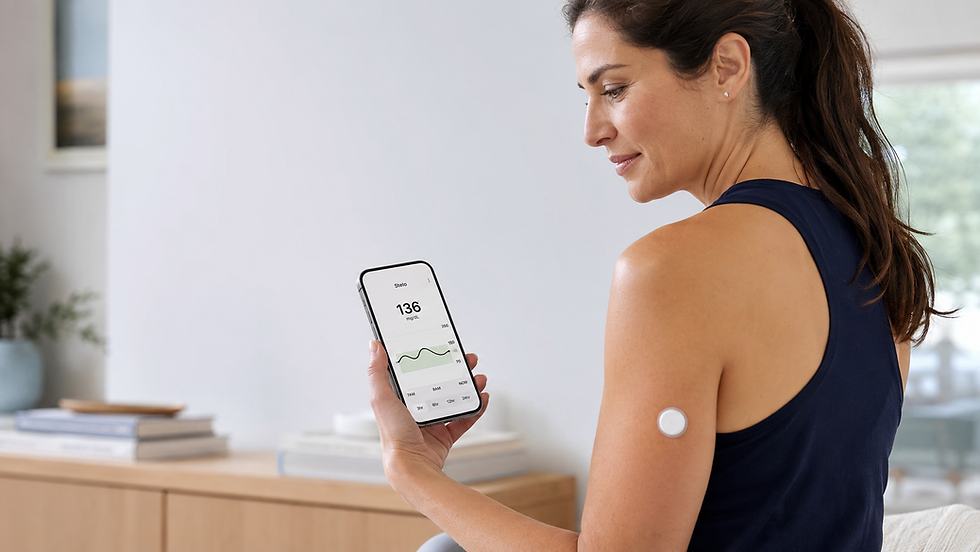
A CGM is a small wearable sensor, usually placed on the upper arm. A tiny filament sits just beneath the skin and measures glucose in the interstitial fluid, the fluid surrounding the body’s cells. Depending on the device, readings are transmitted to a smartphone or reader throughout the day and night. Most systems also display trend arrows, which show whether glucose is relatively steady, rising, or falling [1].
Technically, a CGM does not draw repeated blood samples. Interstitial glucose usually tracks blood glucose closely, but the two are not identical, and a delay can appear when glucose is changing rapidly. That is why an isolated sensor reading should not be treated as a message carved into a stone tablet. The real value lies in the trend created by hundreds of measurements over time—and in whether a finding can be reproduced.
Think of the difference between checking the weather once at noon and operating a weather station around the clock. One gives you a temperature. The other shows the storm moving in, how long it stayed, and when the sky cleared.
Glucose Is Supposed to Move
Glucose is one of the body’s essential fuels. After you eat carbohydrates, digestion breaks many of them down into glucose, which enters the bloodstream. The pancreas releases insulin, a hormone that helps move glucose into muscle, liver, and other cells for immediate use or storage. A rise after eating is therefore not a metabolic emergency. It is physiology doing its job.
The more useful information is in the shape and context of the response. How large was the excursion from your starting level? How long did glucose remain elevated? Did it move back toward baseline? Does the same breakfast repeatedly behave differently from another breakfast? Does the response change after resistance training, a short night of sleep, or a late meal?
None of those questions can be answered responsibly by staring at one dramatic-looking peak. Metabolism is a pattern-recognition problem, not a game of whack-a-mole.
This is also why the goal is not a perfectly flat line. Healthy glucose levels fluctuate, especially after carbohydrate-containing meals. Trying to flatten every bump can encourage unnecessary restriction, anxiety around food, or decisions that make the graph look prettier without making the person healthier. Butter may produce a flatter glucose trace than lentils. That does not make butter a vegetable or the CGM a complete nutrition assessment.
For people with diabetes, established CGM targets—including time spent between 70 and 180 mg/dL—help guide treatment [2,5]. Those targets were not designed as universal wellness grades for every person without diabetes. We do not yet have a single, clinically validated “perfect curve” for all metabolically healthy adults. One blueberry does not need a performance review.
The Same Meal Does Not Always Produce the Same Response
General nutrition principles still matter. Fiber-rich foods, minimally processed carbohydrates, adequate protein, healthy fats, appropriate portions, and regular activity remain sensible foundations. Personalization does not mean nutritional science has dissolved into chaos.
It does mean your physiology gets a vote.
In a landmark study of 800 people and nearly 47,000 meals, investigators found substantial person-to-person differences in post-meal glucose responses [3]. More recent controlled research found meaningful variation even when adults consumed standardized carbohydrate-containing meals. Those differences were associated with underlying physiology, including insulin sensitivity and the pancreas’s ability to release insulin [4].
That does not prove that everyone needs a CGM or that every meal should be custom-engineered to the last chickpea. It shows that population-level advice and individual response can both be true. Brown rice may be a reasonable choice in general, while portion, preparation, meal composition, activity, and a person’s metabolic health still shape what happens next.
A CGM can make those differences visible. It cannot always explain them.
A Two-Week Experiment, Running in the Background
The most useful way to approach a CGM is as a focused 14-day experiment, not lifelong metabolic surveillance. Fourteen consecutive days is also the standard reporting period commonly used to summarize CGM patterns in diabetes care when enough usable data are collected [5]. For someone without diabetes, that does not make two weeks diagnostic or guarantee that every question will be answered. It simply provides a practical window in which repeatable everyday patterns may emerge.
The first few days should look like your normal life. Eat your usual meals. Follow your usual schedule. Resist the urge to become a completely different person because a sensor is watching. If you suddenly replace every meal with grilled salmon and begin walking at sunrise, the CGM may confirm that your temporary alter ego has excellent habits, but it will teach us very little about you.
Once a baseline is visible, change one variable at a time. Suppose oatmeal is your usual breakfast. Compare it with a different portion. Add protein or fiber. Eat it after resistance training. Try a short walk afterward. Repeat the meal on another day rather than declaring victory—or banning oats from the household—after one curve. Controlled studies support meaningful individual variation, and even the same person’s response can vary from day to day [3,4]. Repetition helps separate a pattern from metabolic weather.
Useful questions may include:
Which meals repeatedly produce the largest or most prolonged excursions?
Does changing the portion or adding protein, fiber, or fat alter the response?
Does movement soon after eating change the curve?
Do similar meals behave differently earlier versus later in the day?
Are patterns noticeably different after poor sleep, high stress, or hard training?
What happens in the hours after aerobic exercise or resistance training?
Are recurring overnight or fasting patterns worth evaluating with established clinical tests?
Post-meal movement is particularly reasonable to test. A systematic review found that exercise performed soon after eating generally reduced the acute post-meal glucose response more effectively than exercise before a meal or activity delayed much later [6]. That does not mean ten minutes of walking will produce the same effect in every person or compensate for every meal. It means “take a walk after dinner” is more than grandmotherly folklore—and a CGM can show whether it makes a meaningful difference for you.
The purpose is not to produce a longer list of food rules. It is to find the few changes that deliver the greatest return with the least disruption. Changing the meal, portion, exercise, bedtime, and stress level simultaneously is not an experiment. It is a small lifestyle coup.
Who Is Most Likely to Benefit?
CGM is firmly established in diabetes care. The American Diabetes Association recommends CGM for many adults and children with diabetes, particularly when insulin treatment, hypoglycemia risk, or treatment adjustment makes frequent glucose information clinically valuable [2]. In that setting, CGM is not merely educational; it can directly inform management.
Outside diabetes, the evidence is more modest. A 2024 meta-analysis of randomized trials found favorable but generally small effects when CGM feedback was used as part of behavior-change interventions across populations with and without diabetes [7]. A 2026 systematic review of 23 studies involving 1,074 participants without diabetes found possible improvements in mean glucose and adherence to lifestyle interventions, but no significant improvement in body mass index. The apparent glycemic benefit was greater in people with prediabetes, while healthy participants with normal glucose regulation showed little measurable glycemic improvement [8]. Only five studies with 149 participants contributed to that review’s quantitative analyses, so the findings should be interpreted with appropriate humility.
In practical terms, short-term CGM may be most informative for someone with prediabetes, metabolic syndrome, a strong family history of type 2 diabetes, weight-management goals, or a specific question about how meals and activity affect glucose. It may also motivate some people who understand health advice intellectually but benefit from seeing it happen. “A walk after dinner may help” is information. Watching your own curve change can become an experience, and experiences often do a better job of getting our attention.
For an otherwise healthy person with normal laboratory results and no clear question, CGM may provide interesting data without improving health. Current reviews have also raised concerns about weak benchmarks for people without diabetes, uncertain long-term benefit, anxiety, and unnecessarily restrictive eating [8,9]. More information is not automatically more wisdom. Your phone already sends enough notifications without every sandwich filing a report.
What a CGM Cannot Tell You
A CGM is a useful sensor, but it is not a metabolic crystal ball. It does not directly measure insulin, diagnose insulin resistance, reveal why a pattern occurred, determine the overall nutritional quality of a food, or predict your future health from one unusual afternoon.
It also cannot diagnose diabetes or prediabetes by itself. Established diagnosis relies on laboratory A1C, fasting plasma glucose, a two-hour oral glucose-tolerance test, or random plasma glucose in the appropriate clinical setting. Abnormal CGM patterns may justify a closer look, but the diagnosis belongs to validated testing and the larger medical picture [10].
Sensors have technical limitations as well. Interstitial readings can temporarily differ from blood glucose when levels are changing quickly. Sensors can occasionally produce inaccurate values, and physical pressure or device-specific medication interference may affect particular systems. If a reading is surprising—especially if it conflicts with symptoms or could change treatment—follow the device instructions and confirm it with an appropriate blood glucose measurement or clinical evaluation rather than launching an emergency investigation of last night’s sweet potato [1,2].
CGM data also needs context. A higher post-meal peak may reflect the carbohydrate amount, but it could also be influenced by the meal’s timing, recent exercise, sleep, stress, illness, medication, alcohol, or normal day-to-day variation. The sensor reports what happened to glucose. It does not provide a confession from the cause.
Data without context is just noise with decimals.
From Curves to Decisions
Within a Flexup Wellness Partnership, CGM is available as an optional 14-day add-on rather than something every client automatically needs. That distinction matters. A sensor is most useful when we begin with a real question and end with a practical decision.
During the monitoring period, you live your normal life while noting the variables that make the data interpretable: meals, meal timing, activity, workouts, sleep, and other relevant factors. We can then compare repeatable patterns with your symptoms, medical history, medications, laboratory results, body composition, and goals. The aim is not to hand you a generic “blood-sugar-friendly” menu or crown one breakfast the winner for all eternity. It is to identify a small number of changes worth testing and sustaining.
We may find that portion size matters more than eliminating a food. A post-dinner walk may have an outsized effect. Poor sleep may coincide with a different response the following day. Or the food you were worried about may behave perfectly reasonably, allowing you to stop treating it like a suspect in a police lineup.
Sometimes good data tells us what to change. Sometimes it tells us what we can stop worrying about. Both are useful.
The Real Value of Seeing the Curve
The most interesting thing about CGM is not that it produces more health data. Most of us are already standing knee-deep in health data, wondering which number deserves our attention.
Its value is that it can shorten the distance between a behavior and its visible consequence. You eat, move, sleep, train, or change the timing of a meal. Instead of waiting months for another A1C and reconstructing your life from memory, you can observe how glucose responded in something close to real time.
For the right person, a focused two-week period can make metabolism less abstract and help turn broad advice into a few personalized experiments. It is not lifelong surveillance, a diagnostic shortcut, or a contest to create the world’s flattest graph. It is a tool for asking better questions.
Because the best health plan is rarely the one that produces the most data. It is the one that helps you understand what to do next.
References
U.S. Food and Drug Administration. What Is the Pancreas? What Is an Artificial Pancreas Device System? FDA; updated 2018. Direct link.
American Diabetes Association Professional Practice Committee for Diabetes. 7. Diabetes Technology: Standards of Care in Diabetes—2026. Diabetes Care. 2026;49(Suppl 1)–S165. doi:10.2337/dc26-S007.
Zeevi D, Korem T, Zmora N, et al. Personalized Nutrition by Prediction of Glycemic Responses. Cell. 2015;163(5):1079–1094. doi:10.1016/j.cell.2015.11.001.
Wu Y, Ehlert B, Metwally AA, et al. Individual Variations in Glycemic Responses to Carbohydrates and Underlying Metabolic Physiology. Nature Medicine. 2025;31:2232–2243. doi:10.1038/s41591-025-03719-2.
Battelino T, Danne T, Bergenstal RM, et al. Clinical Targets for Continuous Glucose Monitoring Data Interpretation: Recommendations From the International Consensus on Time in Range. Diabetes Care. 2019;42(8):1593–1603. doi:10.2337/dci19-0028.
Engeroff T, Groneberg DA, Wilke J. After Dinner Rest a While, After Supper Walk a Mile? A Systematic Review With Meta-analysis on the Acute Postprandial Glycemic Response to Exercise Before and After Meal Ingestion in Healthy Subjects and Patients With Impaired Glucose Tolerance. Sports Medicine. 2023;53:849–869. doi:10.1007/s40279-022-01808-7.
Richardson KM, Jospe MR, Bohlen LC, et al. The Efficacy of Using Continuous Glucose Monitoring as a Behaviour Change Tool in Populations With and Without Diabetes: A Systematic Review and Meta-analysis of Randomised Controlled Trials. International Journal of Behavioral Nutrition and Physical Activity. 2024;21:145. doi:10.1186/s12966-024-01692-6.
Liao X, Li Y, Tang S, et al. Continuous Glucose Monitoring in Non-diabetic Populations: A Systematic Review of Observational and Interventional Studies With Meta-analysis. European Journal of Medical Research. 2026;31:397. doi:10.1186/s40001-026-03920-0.
Oganesova Z, Pemberton J, Brown A. Innovative Solution or Cause for Concern? The Use of Continuous Glucose Monitors in People Not Living With Diabetes: A Narrative Review. Diabetic Medicine. 2024;41(9). doi:10.1111/dme.15369.
American Diabetes Association Professional Practice Committee for Diabetes. 2. Diagnosis and Classification of Diabetes: Standards of Care in Diabetes—2026. Diabetes Care. 2026;49(Suppl 1)–S49. doi:10.2337/dc26-S002.



Comments